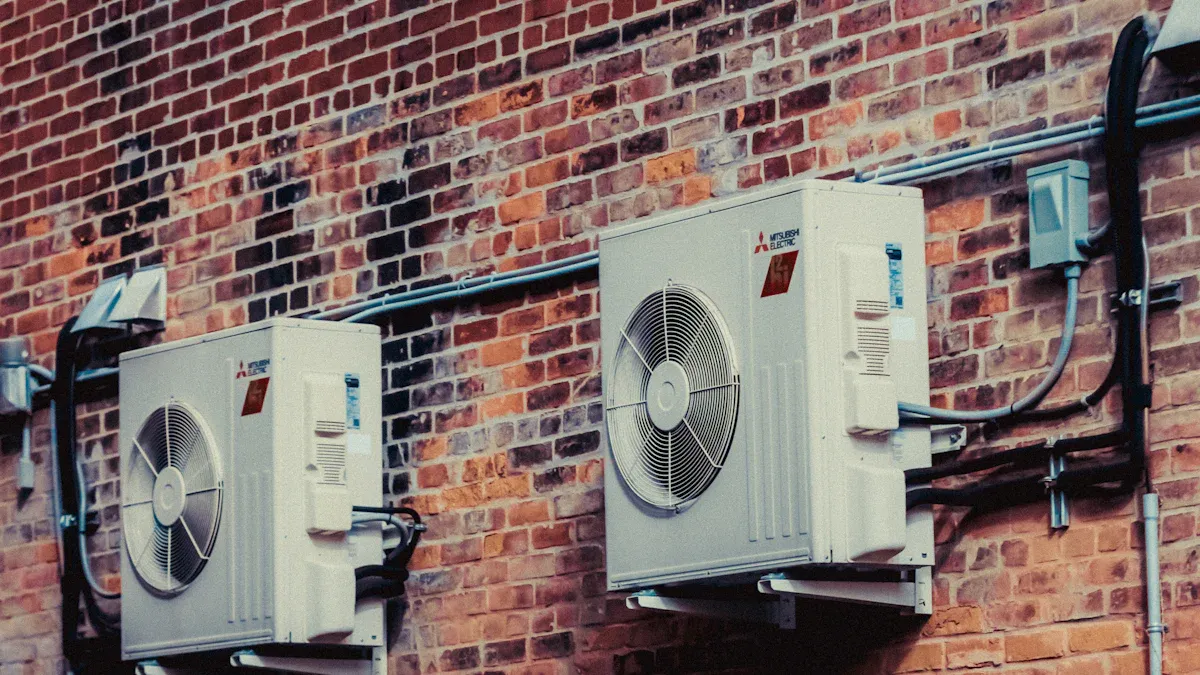
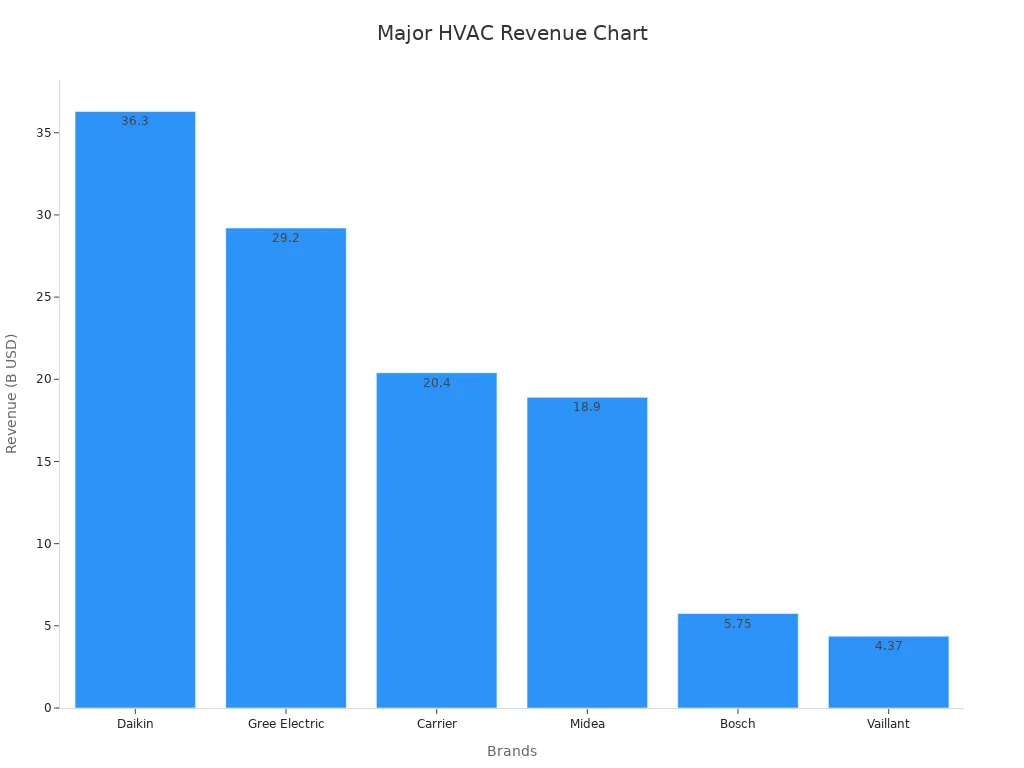
Fewer than 10 HVAC Manufacturers shape the global industry, controlling a significant share of the $255.1 billion market. The table below highlights the scale of this dominance, with brands like Daikin and Carrier leading in revenue and regional influence.
| Brand | 2022 Revenue (USD) | Market Share (%) | CAGR (%) | Regional Leadership |
|---|---|---|---|---|
| Daikin | 36.3 billion | 15.44 | 5.2 | Global leader |
| Gree Electric | 29.2 billion | 12.42 | 4.5 | Dominates China |
| Carrier | 20.4 billion | 8.68 | 2.8 | Leader in North America |
| Midea | 18.9 billion | ~16.5 (China) | 9.1 | Leading China market share |
| Bosch | 5.75 billion | N/A | N/A | Leading Europe (Germany) |
| Vaillant | 4.37 billion | N/A | N/A | Leading Europe |
Top manufacturers validate their claims with rigorous, third-party testing. Organizations such as Intertek confirm that products meet strict industry standards for energy efficiency and operational performance. Advanced AI models now predict HVAC system reliability with remarkable accuracy, ensuring precise temperature and humidity control in critical environments. Choosing a leading manufacturer supports quality installations and dependable service across various applications.
Key Takeaways
- Top HVAC manufacturers like Daikin, Carrier, and Trane lead the global market with strong innovation, energy efficiency, and reliable products.
- U.S. brands such as Carrier, Trane, Rheem, Lennox, and YORK offer advanced technologies and strong warranties that support both residential and commercial needs.
- Global leaders invest in eco-friendly refrigerants, smart controls, and rigorous testing to ensure sustainability and long-term system performance.
- Choosing the right HVAC manufacturer involves assessing needs, comparing product features and costs, and evaluating supplier reputation and support.
- Using data-driven methods and trusted brands helps reduce maintenance costs, improve energy savings, and ensures dependable HVAC system operation.
Leading U.S. HVAC Manufacturers
The U.S. HVAC market has experienced robust growth, driven by innovation and regulatory changes. The commercial HVAC sector reached a value of approximately $58.4 billion in 2023 and is projected to grow to nearly $112 billion by 2032. This expansion highlights the influence and reputation of top U.S. HVAC Manufacturers, who continue to set industry benchmarks for performance, reliability, and energy efficiency.
Carrier
Carrier stands as a pioneer in the HVAC industry, recognized for its commitment to innovation and quality. The company consistently ranks as a market leader, holding a 17% share among U.S. HVAC Manufacturers. Carrier’s product portfolio includes high-efficiency systems, geothermal heat pumps, and Wi-Fi enabled Infinity Series units. These products meet or exceed the latest SEER2 and HSPF2 energy standards, reflecting Carrier’s focus on sustainability and regulatory compliance.
- Carrier introduced a cloud-based diagnostic and remote monitoring platform powered by artificial intelligence. This technology reduces emergency breakdowns by nearly 38% and decreases the need for on-site technician visits for over 44% of users.
- The company received recognition as the best HVAC provider for 2023 by U.S. News & World Report for the second consecutive year. Its Bryant brand also ranked second.
- Carrier’s systems are known for their quiet operation, comprehensive warranties, and a wide range of product options, making them suitable for both residential and commercial applications.
Carrier’s ongoing investment in smart technology and energy efficiency positions it as a preferred choice for contractors and building owners seeking dependable, high-performance HVAC solutions.
Trane
Trane has built a reputation for durability, advanced engineering, and energy efficiency. The company holds a 10% market share and continues to innovate in response to evolving industry standards and environmental regulations. Trane’s product lineup features Energy Star-rated systems, unique Climatuff compressors, and variable speed motors that optimize energy use and system longevity.
- Climatuff compressors deliver durability and efficiency, reducing breakdowns and extending equipment lifespan.
- Spine Fin coils enhance heat transfer and resist corrosion, supporting long-term reliability.
- ComfortLink II controls provide real-time diagnostics and precise management, maintaining peak efficiency and preventing failures.
- Trane’s variable speed technology modulates compressor and fan speeds, reducing wear and maximizing energy savings.
- The company’s rigorous testing protocols ensure products withstand extreme environmental conditions.
- Trane offers comprehensive warranty coverage, typically up to 10 years, reinforcing confidence in long-term performance.
Trane’s high-efficiency units, such as the 17 Multi-Speed Heat Pump and the 20 TruComfort Variable Speed Heat Pump, achieve SEER2 ratings up to 22.4 and HSPF2 ratings up to 11. These models comply with new refrigerant regulations, supporting sustainability goals and regulatory requirements.
| Model Name | SEER2 | HSPF2 | Key Features |
|---|---|---|---|
| 17 Multi-Speed Heat Pump | 17.1 | 11 | Multi-speed, R-454B compliant |
| 18 TruComfort Variable Speed Air Conditioner | 18.1 | N/A | Variable speed, precise energy use |
| 18 TruComfort Variable Speed Heat Pump | 18.1 | 8.5 | Variable speed, energy efficient |
| 20 TruComfort Variable Speed Heat Pump | 22.4 | 10.5 | WeatherGuard, optimal efficiency |
Trane’s focus on reliability and advanced controls makes it a top choice for demanding commercial and residential environments.
Rheem
Rheem has established itself as a trusted name in the HVAC industry, known for delivering reliable and energy-efficient solutions. The company’s product range includes air conditioners, heat pumps, and furnaces designed to meet the needs of both residential and commercial customers. Rheem’s commitment to innovation is evident in its adoption of new refrigerants and compliance with evolving energy standards.
Rheem’s systems often feature advanced control technologies, supporting intelligent operation and improved energy management. The company’s products are engineered for durability, with robust warranties and a strong network of professional installers. Rheem’s focus on sustainability and customer satisfaction has helped it maintain a strong presence among leading U.S. HVAC Manufacturers.
The combination of historical market growth, regulatory compliance, and ongoing innovation ensures that Carrier, Trane, and Rheem remain at the forefront of the U.S. HVAC industry.
Lennox
Lennox stands as a leader among HVAC Manufacturers, recognized for its commitment to energy efficiency and innovation. The company has a long history of introducing advanced technologies that set new standards in the industry. Lennox engineers products that help homeowners and businesses reduce energy consumption and improve indoor air quality.
Lennox’s impact on energy-efficient HVAC solutions includes several notable achievements:
- Lennox created the world’s first air conditioner rated above 20.5 SEER, setting a new benchmark for efficiency.
- The company produces the most efficient gas furnace currently available, helping customers lower heating costs.
- Lennox offers a full line of ultra-low NOx emission furnaces, supporting efforts to reduce harmful emissions and improve air quality.
- The company has received the ENERGY STAR® Manufacturing Partner of the Year award four times, highlighting its leadership in energy-efficient manufacturing.
- The PureAir S system stands out for its ability to purify air without producing lung-irritating ozone, converting existing ozone into clean oxygen.
Lennox continues to invest in research and development focused on sustainability. The company’s partnership with Samsung has led to the creation of advanced mini-split and VRF ductless HVAC systems. These systems combine Lennox’s market expertise with Samsung’s technology, resulting in products that exceed industry standards for performance and energy efficiency.
The EL297V gas furnace, which received the GOOD DESIGN® Award, demonstrates Lennox’s dedication to superior design and high energy efficiency. Lennox’s innovations align with strict regulatory standards and help customers reduce their carbon footprint. The company’s focus on sustainability and advanced technology ensures that its products remain at the forefront of the HVAC industry.
Lennox’s ongoing commitment to energy efficiency, air quality, and innovative design makes it a top choice for contractors and building owners seeking reliable, environmentally responsible HVAC solutions.
YORK
YORK, a brand under Johnson Controls, has built a reputation for delivering reliable and efficient HVAC systems for both residential and commercial applications. The company’s history dates back to 1874, making it one of the oldest names in the industry. YORK engineers its products to meet the demands of modern buildings, focusing on comfort, efficiency, and ease of maintenance.
YORK’s product lineup includes air conditioners, heat pumps, furnaces, and packaged systems. The company’s Affinity™ Series air conditioners and heat pumps achieve high SEER ratings, helping customers save on energy costs. YORK’s variable-speed technology allows systems to adjust output based on demand, improving comfort and reducing energy use.
YORK places a strong emphasis on reliability. The company tests its products under extreme conditions to ensure long-lasting performance. YORK’s systems feature advanced controls that allow users to monitor and adjust settings remotely, providing greater flexibility and convenience.
YORK also supports sustainability through the use of environmentally friendly refrigerants and energy-efficient designs. The company’s commitment to innovation is evident in its ongoing development of smart HVAC solutions that integrate with building automation systems.
- YORK’s residential and commercial systems offer quiet operation, robust warranties, and flexible installation options.
- The company’s products meet or exceed current energy efficiency standards, supporting green building initiatives.
- YORK’s global presence ensures access to a wide network of service professionals and technical support.
YORK’s blend of tradition, innovation, and reliability positions it as a trusted choice for those seeking high-performance HVAC systems.
Top Global HVAC Manufacturers
The global HVAC industry continues to expand, driven by rapid urbanization, stricter energy regulations, and the adoption of smart technologies. Leading HVAC Manufacturers set the pace for innovation and efficiency, shaping the future of climate control worldwide. The Asia-Pacific region leads in market share, with significant growth projected across all continents.
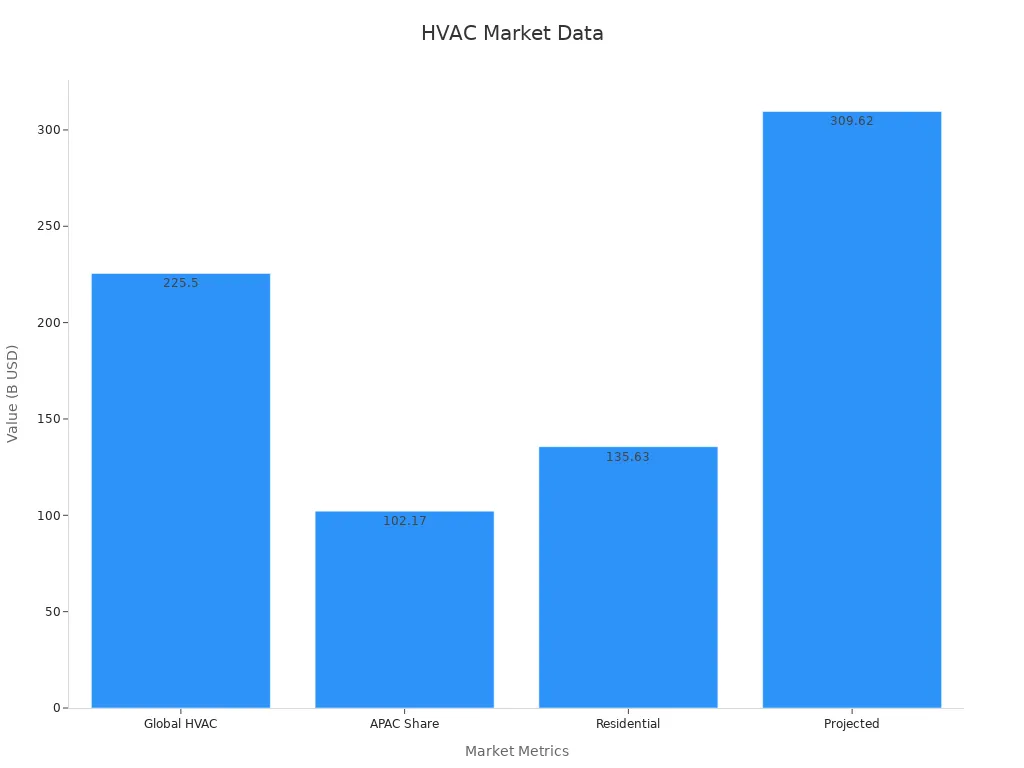
| Metric | Value (USD Billion) | Year/Period |
|---|---|---|
| Global HVAC Market Size | 225.50 | 2022 |
| Projected Market Size | 309.62 | 2028 |
| CAGR | 5.43% | 2022-2028 |
| APAC Region Market Share | 102.17 | 2022 |
| Residential HVAC Market Size | 135.63 | 2022 |
Key growth drivers include construction booms, energy efficiency trends, and the integration of smart features. Major acquisitions, such as Bosch acquiring Johnson Controls’ HVAC business, highlight the competitive landscape. The following companies stand out for their global influence and technological leadership.
Daikin
Daikin holds a dominant position among global HVAC Manufacturers. The company achieved record sales of €28 billion in fiscal year 2023, reflecting its commercial strength and broad market reach. Daikin remains the only manufacturer worldwide that develops and produces HVAC-R equipment, compressors, and refrigerants entirely in-house. This unique capability ensures quality control and rapid innovation.
Daikin’s commitment to sustainability and efficiency appears in its R&D strategy, known as the Fusion 25 Plan. The company focuses on carbon neutrality and customer-centric solutions. Daikin leads the industry in the development of inverter compressor technology and low-GWP refrigerants, such as HFC-32. By granting free access to 93 patents for HFC-32, Daikin has accelerated the adoption of energy-saving, low-emission refrigerants worldwide.
The company consistently ranks among the world’s top 100 most innovative companies, as recognized by LexisNexis and Clarivate. Daikin’s installer and engineer support programs ensure high installation standards and system performance. These efforts contribute to superior energy efficiency and customer satisfaction.
| Innovation & Efficiency Aspect | Supporting Details |
|---|---|
| Innovation Recognition | Top 100 global innovator (multiple years) |
| Patent Leadership | Free access to HFC-32 patents globally |
| R&D Focus | Carbon neutrality, customer value |
| Manufacturing Integration | Full in-house production |
| Efficiency Technologies | Inverter compressors, low-GWP refrigerants |
| Sales Record | €28 billion (FY2023) |
Daikin’s leadership in innovation, efficiency, and sustainability sets a benchmark for the global HVAC industry.
LG Electronics
LG Electronics has established itself as a key player in the global HVAC market, focusing on smart, energy-efficient solutions for both residential and commercial applications. The company’s Multi V systems use scroll type inverter compressors, allowing one outdoor unit to connect with up to 52 indoor units. Each indoor unit operates independently, providing precise temperature and fan speed control for zoned comfort.
LG’s advanced zoning technology optimizes energy use by adjusting capacity based on real-time demand. Cooling capacities range from 76,400 to 310,000 Btu/h, supporting a wide variety of building sizes. LG’s oil-free inverter centrifugal chillers use eco-friendly R1233zd refrigerant, reducing mechanical losses and operational costs. Air-cooled inverter scroll chillers utilize R32 refrigerant, increasing cooling capacity by 7% and enabling efficient partial load operation.
- LG Multi V systems deliver flexible zoning and independent control for each indoor unit, resulting in significant energy savings.
- Oil-free inverter centrifugal chillers provide high efficiency and sustainability.
- Chiller solutions are customizable for demanding environments, including AI data centers, with capacities up to 50,000 RT.
- LG’s focus on smart controls and low-GWP refrigerants aligns with global trends in sustainability and indoor air quality.
LG’s commitment to innovation and environmental responsibility positions the company as a leader in delivering advanced, eco-conscious HVAC solutions worldwide.
Toshiba
Toshiba continues to drive international HVAC system performance through advanced technology and energy-saving solutions. In November 2024, Toshiba Carrier launched a new heat recovery VRF system designed for large commercial buildings. This system enables simultaneous heating and cooling, which enhances energy efficiency in hotels, office complexes, and other multi-zone environments.
Toshiba’s VRF technology allows for precise temperature control and reduced energy consumption. The company’s focus on innovation supports the growing demand for efficient, flexible HVAC systems in global markets. Toshiba’s ongoing product development reflects a commitment to sustainability and operational excellence.
Toshiba’s advancements in VRF and heat recovery systems demonstrate its contribution to efficient, high-performance HVAC solutions on a global scale.
Ingersoll Rand
Ingersoll Rand stands as a global leader in industrial technologies, with a strong presence in the HVAC sector through its Trane brand and advanced air compressor solutions. The company’s reputation for reliability and performance stems from a legacy of over 160 years of innovation and strategic acquisitions. Ingersoll Rand’s approach to product development emphasizes rigorous testing, advanced controls, and a commitment to sustainability.
- Trane HVAC systems undergo extensive durability testing, ensuring long-term performance in demanding environments.
- ComfortLink™ II technology enables precise temperature control, which enhances both user comfort and system efficiency.
- Many Trane products meet or exceed international energy efficiency standards, reflecting the company’s dedication to sustainable solutions.
- Strict dealer standards and unique product features reinforce the reliability and performance of Trane systems.
Ingersoll Rand’s air compressors incorporate adaptive controllers that continuously monitor and adjust performance parameters. These controllers use sophisticated algorithms to adapt to changing environmental conditions, optimizing energy efficiency and reducing downtime. The compressors feature superior components and benefit from a global parts and service network, which ensures ongoing operational support and maintenance.
Ingersoll Rand’s focus on innovation, adaptive technology, and global support makes it a trusted choice among HVAC Manufacturers for businesses seeking dependable, high-performance solutions.
Mitsubishi Electric
Mitsubishi Electric holds a prominent position in the global HVAC market, recognized for its durable, energy-efficient, and technologically advanced systems. The company’s HVAC products, especially its IT Cooling Systems, demonstrate a strong emphasis on reliability and operational longevity. Mitsubishi Electric leverages advanced inverter technology and compact designs to deliver high efficiency and continuous 24/7 operation, even in mission-critical environments.
Their DX Cooling Systems, developed with over 50 years of telecommunications experience, maintain high Sensible Heat Ratios (SHR) and Energy Efficiency Ratios (EER). These features ensure efficient heat management and energy use, which reduces operational stress and minimizes maintenance needs. Mitsubishi Electric designs its systems with full frontal accessibility and a limited parts list, making inspection and maintenance straightforward and efficient.
Mitsubishi Electric’s recent expansion of heat pump production capacity in Europe highlights its commitment to sustainable and durable HVAC solutions. This strategic move aligns with Europe’s green energy transition and regulatory requirements. The company’s focus on energy-efficient and long-lasting heating and cooling technologies reinforces its leadership among global HVAC Manufacturers.
Mitsubishi Electric’s dedication to durability, efficiency, and sustainability ensures its continued influence in the evolving HVAC industry.
Samsung Electronics
Samsung Electronics has emerged as a key innovator in the global HVAC market, offering advanced solutions that prioritize energy efficiency, smart technology, and indoor air quality. The company’s Hylex™ electric heat pump system integrates heating and cooling in a single unit, reducing CO2 emissions and total energy consumption. This system also operates quietly, making it suitable for residential and commercial spaces.
Samsung’s DVM S2 VRF system delivers industry-leading efficiencies and supports global decarbonization goals, such as net-zero electricity grids by 2035 and net-zero emissions by 2050. The WindFree™ 3.0i mini split system improves indoor air quality through advanced filtration, capturing ultra-fine dust particles as small as PM 1.0. The 360 Cassette features a bladeless design and directional airflow control, maximizing energy savings and comfort.
- Samsung provides comprehensive HVAC training programs to ensure quality installation, service, and maintenance.
- The company’s focus on technological advancement and smart HVAC solutions extends across residential, light commercial, and commercial sectors.
Samsung Electronics continues to set benchmarks for innovation, energy management, and user comfort, reinforcing its reputation as a leading force among global HVAC Manufacturers.
HVAC Manufacturers Comparison Table

Selecting the right HVAC brand involves more than just comparing prices or features. Industry professionals often rely on statistical measures and evidence-based criteria to evaluate reliability, efficiency, and customer trust. The Net Trust Quotient Score (NTQS) offers a standardized way to compare leading brands based on consumer perceptions of reliability and satisfaction.
| Rank | Brand | Net Trust Quotient Score |
|---|---|---|
| 1 | Trane | 113.4 |
| 2 | Carrier | 112.5 |
| 3 | Lennox | 107.2 |
| 4 | Rheem | 104.3 |
| 5 | Whirlpool | 104.0 |
| 6 | Goodman | 103.2 |
| 7 | Bryant | 102.9 |
| 8 | American Standard | 102.1 |
| 9 | York | 100.9 |
| 10 | Mitsubishi | 98.0 |
| 11 | Ruud | 97.7 |
| 12 | Amana | 96.9 |
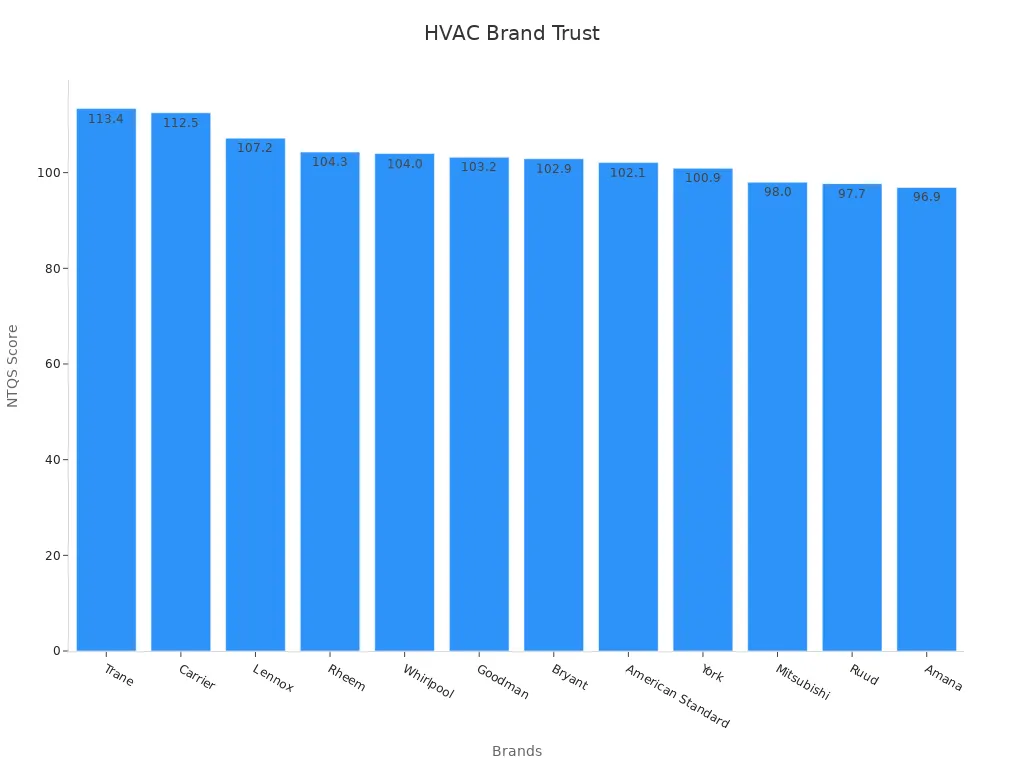
The NTQS uses consumer survey data, standardized through rigorous statistical methods, to ensure valid and objective brand comparisons. This approach highlights differences in reliability and customer satisfaction across the industry.
Beyond trust scores, several criteria help verify a manufacturer’s reliability and efficiency. These include certifications, advanced technologies, product testing, and warranty programs. The table below summarizes the most important factors:
| Criteria | Description |
|---|---|
| Certifications | AHRI, ENERGY STAR, ISO 9001/14001, CE, and others confirm product quality and efficiency. |
| Advanced Technologies | Inverter compressors, smart Thermostats, and eco-friendly refrigerants boost performance. |
| Product Testing | 100% run-testing and ISO standards ensure consistent reliability. |
| Efficiency Ratings | High SEER and ENERGY STAR ratings validate energy-saving capabilities. |
| Warranty & Customer Service | Strong warranties and support reflect manufacturer confidence and reliability. |
| System Complexity & Usage | Residential and commercial system differences reveal manufacturer expertise. |
| Innovation Impact | Smart controls and advanced filtration improve comfort and air quality. |
These criteria, combined with trust scores, provide a comprehensive view for comparing brands. Professionals can use this information to make informed decisions that balance performance, reliability, and long-term value.
How to Choose the Right HVAC Manufacturer or Supplier
Assess Needs and Budget
Every project begins with a clear understanding of requirements and financial boundaries. Decision-makers should evaluate the size and type of building, climate zone, and expected occupancy. Matching system capacity to actual needs ensures optimal performance and cost-effectiveness. Budget planning must account for more than just the initial purchase price. Hidden expenses, such as permits, electrical upgrades, and installation labor, often impact the total investment. Government incentives, like those from the Inflation Reduction Act, can offset upfront costs for high-efficiency systems. Life-Cycle Cost Analysis (LCCA) provides a comprehensive view by considering operational and maintenance expenses over the system’s lifespan. This approach highlights that initial costs represent only a small fraction of total ownership expenses, making long-term savings a critical factor in the selection process.
Research and Shortlist HVAC Manufacturers
A structured research process streamlines the selection of suitable suppliers. Stakeholders often use standardized models, such as US DOE prototype buildings, to benchmark energy performance and automate input analysis. Project scope factors—like system performance tiers, capital cost categories, heating source types, and space requirements—help narrow down options. For example, evaluating energy use intensity (EUI) and installation cost per square foot ensures alignment with both sustainability goals and budget constraints. Decision-makers should also consider the physical footprint of equipment to confirm compatibility with building limitations. The Choosing by Advantages (CBA) method, enhanced with probabilistic updates, integrates statistical modeling to quantify uncertainty and variability in performance attributes. This data-driven framework increases transparency and supports collaborative decision-making, helping teams identify the most advantageous supplier.
| Methodology Aspect | Description | Performance Data Used |
|---|---|---|
| DOE Prototype Buildings | Standardized energy benchmarks | EUI, baseline energy codes |
| Project Scope Factors | System performance, cost, heating source | EUI, cost/ft², source type |
| Performance Tiers | Efficiency categories | Utility bill estimates |
| Space Requirements | Equipment fit within building constraints | Size tiers |
Compare Quotes and Product Offerings
Comparing supplier quotes involves more than reviewing prices. A thorough cost-benefit analysis examines initial investment, operational costs, energy savings, and potential increases in property value. Energy-efficient systems often qualify for rebates and tax credits, further improving return on investment (ROI). Calculating ROI requires summing all costs and benefits, then applying the formula:
ROI = ((Total Benefits – Total Costs) / Total Costs) × 100
For example, a $50,000 upgrade with $10,000 in annual benefits achieves a 100% ROI over five years. Payback period, calculated as initial investment divided by annual savings, offers another useful metric. Modern platforms now streamline the quote-to-order process, provide real-time updates, and enhance collaboration between suppliers and clients. These tools deli